
Mawlana Shah Rahim al Hussaini remarked on Vancouver’s stunning natural beauty during his first padhramni — auspicious visitation of the Imam filled with prayers, blessings, and spiritual reflection — Sunday, July 26, 2026. The Didar (lit. a glimpse) occurred at the Vancouver Convention Centre, situated spectacularly along the Burrard Inlet (Səl̓ilw̓ət in local indigenous language), where orca whales, seals, sea lions, salmon and herring swim back and forth from the Pacific Ocean. Clouds concealed the peaks of the North Shore mountains on the day of Didar; nevertheless, murids entering the building were greeted by a magnificent view of birds, seaplanes and ships through the large floor-to-ceiling windows. The neighbouring Canada Place’s Sails of Light, illuminated in red and green, the colours of the Ismaili Imamat flag, shone like beacons the night before to announce the presence of the Aga Khan in the city.
It rains frequently during the winter in the Lower Mainland of British Columbia, but the region had been experiencing summer drought for weeks before the padhramni. It seemed remarkable then that rain fell continually on the day of Didar. This reminded me of a wa’z (sermon) of the late Mukhi Mohamed Adra of Syria in a Vancouver Jamatkhana some four decades ago. Noting the abundant descent of winter precipitation, he said that the city’s residents seemed to be favoured because rain is a symbol of blessings. Of course, prayer also induces blessings. A hadith — tradition — of Prophet Muhammad (may peace be upon him and his progeny) narrates Angel Jibreel (Gabriel) saying that it was possible for him to count all the drops of a rainfall, but he found it impossible to count the blessings evoked by a believer’s salawat (Allahumma salli ala Muhammadin wa aali Muhammad — O Allah, send Your grace, honour, and mercy upon Muhammad and the family of Muhammad). Some 15,000 murids recited many salawat in unison during padhramni. Blessings filled Didar Hall even as they came down from the heavens outside — it was a busy day for angels.
A hadith of Prophet Muhammad narrates Angel Jibreel (Gabriel) saying that it was possible for him to count all the drops of a rainfall, but he found it impossible to count the blessings evoked by a believer’s salawat (Allahumma salli ala Muhammadin wa aali Muhammad — O Allah, send Your grace, honour, and mercy upon Muhammad and the family of Muhammad). Some 15,000 murids recited many salawat in unison during padhramni.
Murids recited Zikr tasbihs, Ginans and Qasidas before, during and after the Didar. Certain Ginans that I had been hearing since childhood were vibrant with special meaning: “Darshan dio moraa naath daasi chhu(n) teri (Grant me your vision of your auspicious presence my Lord, I am your servant) sung prior to the Imam’s arrival, heightened anticipation for Darshan / Didar. Upon the Imam’s departure, “Jire vaalaa dhan re ghaddi jo din sant padhaaryaa” (O beloved brothers, precious is the time when the holy personage graces us with his presence) and “Eji Aanand aanand kariyo rikhisaro, aval Shah tame paayaa” (Rejoice and be happy, O inspired believers, you have attained the pre-eminent Sovereign) expressed the deep contentment and bliss of experiencing Didar.
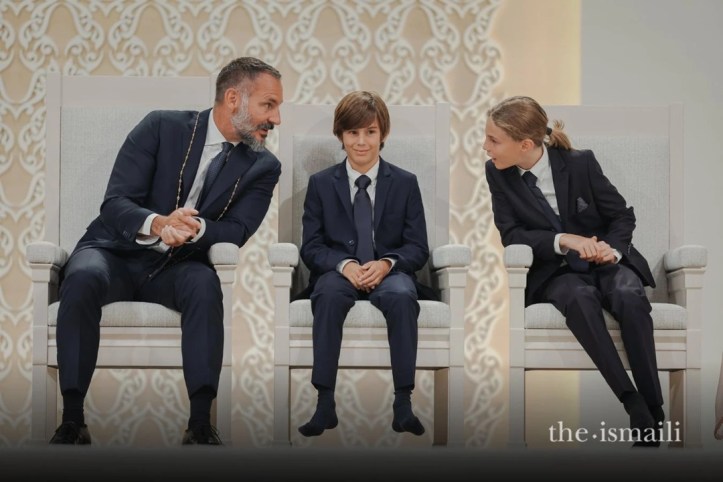
The recitations reaffirmed the Shia belief in Imamat, whose origins are in Prophet Muhammad’s declaration of Hazrat Ali (peace be upon him) as Mawla at Ghadir Khumm following his last pilgrimage to Mecca. A core tenet of the Shia Ismaili faith is the continuity of Imamat in Ali’s descendants, designated one after the other through nass (spiritual designation) by the preceding Imam. Mawlana Shah Rahim is the 50th Imam in this holy lineage. The Jamat was delighted that the Imam had brought his sons Prince Irfan and Prince Sinan with him to the padhramni.
Mukhisaheb of Vancouver Darkhana pledged allegiance (bay’a in Arabic and bayat in South Asian and Persian languages) to Shah Rahim, accepting him as the Imam, Murshid and Pir on behalf of assembled murids. Shah Rahim graciously acknowledged the bay’a and blessed his followers. He asserted that the pledge cannot be imposed but is offered as an expression of the individual murid’s own loyalty and love. He said that the bay’a created a spiritual connection and mutual responsibility: the Imam guides his followers to attain their spiritual and material potential while the murids’ obligation begins with performing the Shia Islamic declaration of faith (shahada / pak kalima / kalmo) and extends to a lifelong journey of spiritual reflection and of serving Allah’s creation, including humanity.
Making a distinction between faith and community, Imam Shah Rahim welcomed non-Ismaili members of Ismailis’ families as part of the community. This harkens back to the time of the Prophet when non-Muslims like Jews and Christians in Madina were considered part of his community (Umma). The Imam also recognized the variations in belief among his adherents and that the degree of faith may change in the course of a person’s lifetime. He assured his followers that he continued to love murids as they wrestled with the vagaries of belief. Shah Rahim reminded the Jamat that God had endowed each individual with intellect (aql) with which they should explore deep questions of faith. True freedom comes from acting upon one’s convictions that are arrived at by exercising the intellect, he said.
Such profound guidance of the Murshid demonstrated the clarity and maturity of his engagement with murids. As the Pir communicated with the large assembly, he interacted with individuals as if he were speaking to them personally– with insight into their struggles. It is around one and a half years since Shah Rahim became the Imam, following the demise of his father, Shah Karim, on February 4, 2025. However, the new Imam has eased into his position as the Imamat has continued uninterrupted. Each Murshid has an individual personality, comportment and demeanor, manifesting himself as Imam az-Zaman (Imam of the Time), but the core message and orientation towards murids has remained consistent for 14 centuries. The jamat is at peace with the smooth transition of Imamat that took place from their much-beloved Shah Karim, who had led them for 68 years, to his son Shah Rahim.
Mawlana Shah Rahim Hazar Imam’s two-hour padhramni was brief but immensely uplifting. Murids’ faces expressed the deep happiness that they felt. Their Pir had conveyed open-hearted affection for his murids, some of whom had experienced zahiri (physical) Didar of the Imam of the Time for the first time in their lives.
Some among the assembled murids in Vancouver remembered Mawlana Shah Karim’s first padhramni to Vancouver in November 1978. The settlement of Ismailis in Canada had occurred at least by the early 1950s and the numbers began to grow substantially after the arrival of refugees from Uganda in 1972. There was much anticipation and excitement in the Jamat when Shah Karim and Begum Salimah (Shah Rahim’s mother) arrived in the country. The Jamat was graced with three marvellous days of Didar in Vancouver. A newly-uploaded video of the iconic geet (song) Mara Mawla Canada Padharshe, an original composition of Shamshu Jamal who sang it with Khursheed Nurali (both Vancouver residents) contains several scenes of the 1978 padhramni. It shows Shah Karim’s and Begum Salimah’s delight at being with the Jamat. Mukhis and Kamadias wore the striking golden pagri (turban) and red jabo (cloak) traditional to the Khoja Ismaili Jamat. The murids, who were mostly of Indian origin from East Africa, are filmed praying, celebrating and rejoicing.
The jamat in Canada is now generally more settled, with at least two generations of Ismailis having been born in the country. It is also more diverse, having had additional migration from various parts of Africa, Afghanistan, Pakistan, India, Iran, Tajikistan and Syria. Some murids have achieved remarkable success in entrepreneurship, professions, politics, media, academia and the arts. The British Columbian Jamat is an aging Jamat, as evidenced by the thousands of murids who sat on chairs at the 2026 mulaqat. A significant number were in wheelchairs and others on portable medical beds. Less noticeable to the eye were those severely debilitated by financial difficulties, as most people were dressed in their finest for the Didar. Shah Karim had first brought the issue of ultra-poverty to the attention of the Jamat during his Golden Jubilee in 2008. It is a persistent problem that many of the more well-off murids have difficulty recognizing and understanding, partly because of the deceptive self-image of a uniformly successful Canadian Jamat.

Shah Rahim encouraged those murids who have achieved economic stability to help improve the lives of others and enable them to live in dignity. Poverty has many factors that insidiously interact with each other, not allowing it to be solved with a quick fix. People caught in the web of the problem are trapped in the cycle of the rise and falls in financial status. Mawlana Hazar Imam conveyed his desire to see everyone in his community to be happy. The Jamat and institutions have the vital task of being clear-eyed, serious, and determined in comprehending and tackling this complex long-term challenge. It is not only a matter of kindness and generosity, which are necessary, but also of using the intellect proficiently.
Mawlana Shah Rahim Hazar Imam’s two-hour padhramni was brief but immensely uplifting. Murids’ faces expressed the deep happiness that they felt. Their Pir had conveyed open-hearted affection for his murids, some of whom had experienced zahiri (physical) Didar of the Imam of the Time for the first time in their lives.
Individuals departed Didar Hall and stepped back into the rain with a sense of being profoundly blessed. They carried a renewed sense of purpose inspired by Mawlana Hazar Imam’s unique insights and enlightened guidance.
Date posted: August 2, 2026.
__________________

About the author: Karim H. Karim is Professor Emeritus of Carleton University’s School of Journalism and Communication, of which he was the Director. He is also an Adjunct Professor at Simon Fraser University and Resident Scholar of its Centre for Comparative Muslim Studies. Dr. Karim has previously served as Director of Carleton’s Centre for the Study of Islam and of the Institute of Ismaili Studies (IIS). He has been a Visiting Scholar at Harvard University and helped the Aga Khan University and the University of Central Asia establish their respective programs in media and communications. Professor Karim won the Canadian Communication Association’s inaugural Robinson Prize for excellence in Communication Studies and the IIS’s inaugural Alumni Recognition Award for leadership and professional achievement. The Government of Canada has honoured him for facilitating dialogue among Canada’s religious communities. Karim has published extensively on Muslims, including Ismailis, communication, and technology. His interdisciplinary writings have large numbers of international citations and he has delivered keynote addresses around the world.
_____________
Please click SUBSCRIBE and enter your email address to receive update notifications from Barakah. Before you leave, remember that Barakah’s editor, Malik, is here to assist you. If you have any questions or feedback, please scroll down to leave a comment or send an email to mmerchant@barakah.com. Also, don’t miss the opportunity to explore the diverse and extensive content on Barakah’s Home Page or Table of Contents, with over 350 pieces dedicated to Mawlana Hazar Imam, members of his family and the Ismaili Imamat. And don’t forget to visit our sister websites, Simerg and Simergphotos. You can stay updated by following Malik on @Facebook, @X, @LinkedIn and @Instagram and by subscribing to Barakah.


Thank you for the wonderful article. It is a much appreciated contribution to the Eastern Canada Jamath’s participation in the Western experience. I myself was much obliged for the insightful and incisive reference to ultrapoverty, which reminds us of the serious responsibility entrusted by our Imams.
LikeLike
Malik once again a fantastic blog with good knowledgeable information and pictures by Professor Karim H. Karim. He is just superb! Malik, on behalf of all your readers around the world, I commend from my heart the continuous efforts on your part also. Prayers that you have the opportunity to do so for a very long time in the future. Ameen.
Our most beloved Hazar Imam (Spiritual Leader)’s visits to his Murids (Followers) are timeless and His Holy Farmans (Words of Guidance etc.) will benefit all around the world for many generations to come. Ameen.
Malik, I have been following all your blogs but did not have chances to submit my comments for the same.
With best wishes, warm regards, affectionate thoughts and prayers for all our sisters and brothers across the world.
Kamrudin A. Rashid, Toronto, Ontario, Canada.
August 4 2026.”
LikeLike
Forever, the most beautiful picture would be Mawlana Hazar Imam, Prince Irfan, and Prince Sinai on stage
LikeLike
Dear Malik:
As always, I truly enjoy each & every article on Barakah, Simerg & Simerg Photos including Professor Karim’s reflection on the Didar in Vancouver.
Thank you & Bless you for sharing such “amazing” information.
Rashida Tejani
LikeLike
Thank you for sharing and reflecting on nature and wisdom shared by the Imam. May we continue to understand and share.
LikeLike