“The waters of a river do not turn back; neither does one’s age”,
and “Gold remains in this world but right conduct (adab) enables you to meet your lord.” — Hazrat Ali’s Kalame-i Mawla
According to tradition, Mawlana Murtaza Ali (may peace be on him), the first Shia Imam, was born on the 13th day of the Islamic month of Rajab, approximately twenty one years before the Hegira or the migration of the Prophet Muhammad (may peace be upon him and his progeny) from Mecca to Medina, from which the Muslim calendar begins.
The Islamic calendar follows the lunar cycle (29-30 days) and is thus shorter than the Gregorian calendar by approximately 14 days every year. For the year 2024, the Ismaili Shias will be observing the birth of Hazrat Ali on or around January 24, in their respective Jamatkhanas around the world. The commemoration includes readings on Imam Ali as well as inspiring recitations of Ginans and Qasidas signifying the importance of Hazrat Ali’s birth and his exemplary life.
~~~~~~~~~~~~
Sayings of Hazrat Ali
THE IMAMS
We are the tree of Prophethood,
the place of descent
of Divine revelation,
the place of frequenting
of the angels,
and the mainsprings of knowledge.
Those who help us and love us
await (God’s) mercy
~~~~
THE BLESSED
Blessed is one
who is humble regarding himself,
whose livelihood is good,
whose inner thoughts are virtuous,
whose character is good,
who spends the surplus from his wealth
and removes superfluity from his speech,
who keeps his evil away from people.
~~~~
TENDER HEART
Have a tender heart,
as tender as a fistful of green grass;
be not arrogant and stiff as a tree
upright in a forest;
A tree is toppled in a storm,
but grass bends and sways
happily with the wind. – Kalame-i Mawla, 8:67
~~~~
GOLD VS. RIGHT CONDUCT
Gold remains in this world but right conduct (adab)
enables you to meet your lord. –- Kalame-i Mawla, 3:16
~~~~
ALWAYS LOOK AHEAD
The waters of a river do not turn back;
neither does one’s age —- Kalame-i Mawla, 7:234
____________________
Preamble of the Ismaili Constitution
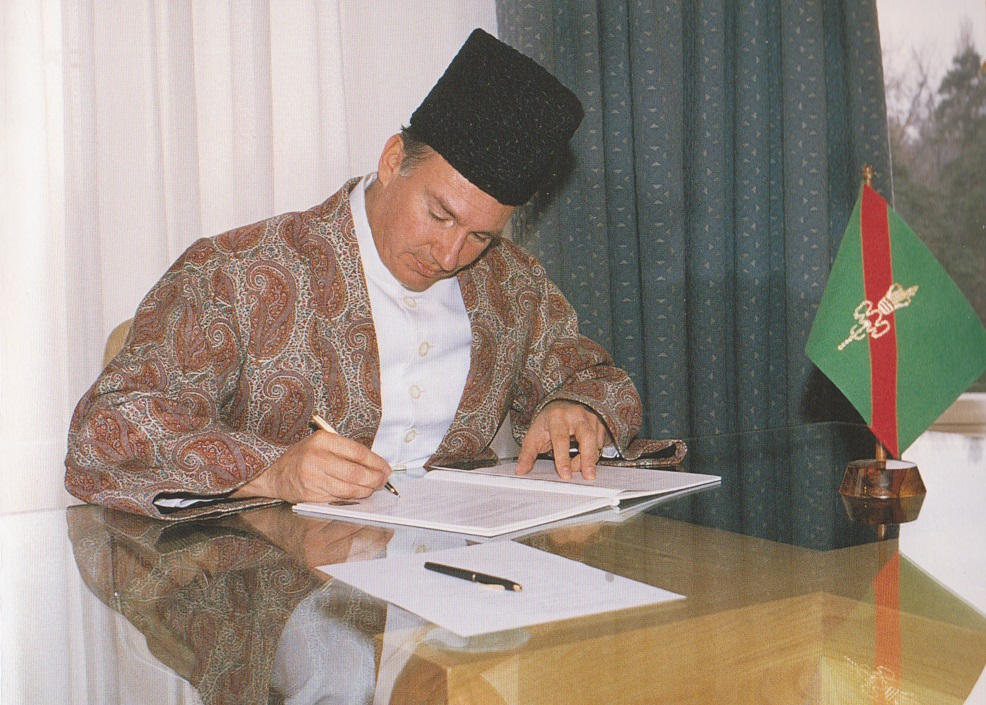
B. In accordance with Shia doctrine, tradition, and interpretation of history, the Holy Prophet (s.a.s.) designated and appointed his cousin and son-in-law Hazrat Mawlana Ali Amiru-l-Mu’minin (a.s), to be the first Imam to continue the Ta’wīl and Ta‘līm of Allah’s final message and to guide the murids, and proclaimed that the Imamat should continue by heredity through Hazrat Mawlana Ali (a.s) and his daughter Hazrat Bibi Fatimat-az-Zahra, Khātun-i-Jannat (a.s).
C. Succession of Imamat is by way of Nass, it being the absolute prerogative of the Imam of the time to appoint his successor from amongst any of his male descendents whether they be sons or remoter issue.
G. Mawlana Hazar Imam Shah Karim al Hussaini, His Highness Prince Aga Khan, in direct lineal descent from the Holy Prophet (s.a.s.) through Hazrat Mawlana Ali (a.s.) and Hazrat Bibi Fatima (a.s), is the Forty-Ninth Imam of the Ismaili Muslims (read full preamble HERE.)
____________________
The Aga Khan on Hazrat Ali
I
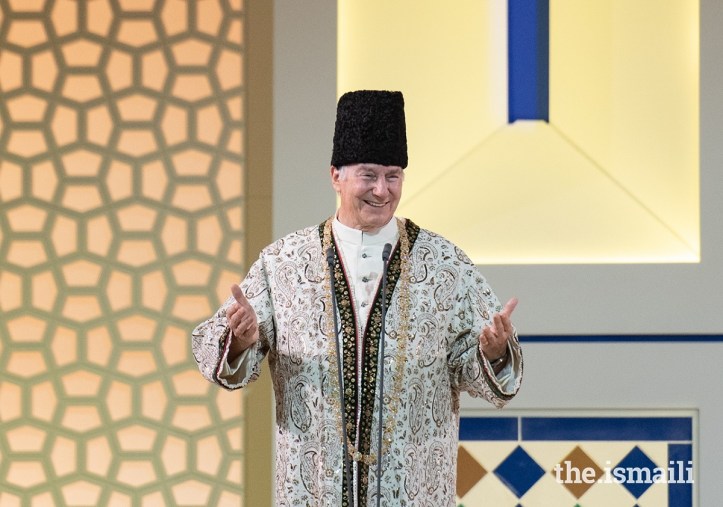
The religious leadership of the Ismaili Imam goes back to the origins of Shia Islam when the Prophet Muhammad appointed his son-in-law, Ali, to continue his teachings within the Muslim community. The leadership is hereditary, handed down by Ali’s descendants, and the Ismailis are the only Shia Muslims to have a living Imam, namely myself. It is the presence of the living Imam that makes our Imamat unique. – Interview, “The Power of Wisdom” , Politique Internationale
II
This is a time of new freedoms, but it is also one in which new choices must be made wisely. In exercising freedom and making choices, our institutions must be guided, as they have been in the past, by the teachings of the Prophet Muhammad (Peace of Allah be upon him), and the tradition of our tariqah, which is the tradition of Hazrat Ali: A thinking Islam and a spiritual Islam – an Islam that teaches compassion, tolerance and the dignity of man – Allah’s noblest creation. – May 14, 1992, Message, Aga Khan Foundation 25th anniversary.
III
From the very beginnings of Islam, the search for knowledge has been central to our cultures. In his teachings, Hazrat Ali emphasized that “No honour is like knowledge.” And then he added that “No belief is like modesty and patience, no attainment is like humility, no power is like forbearance, and no support is more reliable than consultation.” Notice that the virtues endorsed by Hazrat Ali are qualities which subordinate the self and emphasize others – modesty, patience, humility, forbearance and consultation. What he thus is telling us, is that we find knowledge best by admitting first what it is we do not know, and by opening our minds to what others can teach us. – June 15, 2006, American University in Cairo.
____________________
The Prayer of Nadi Ali
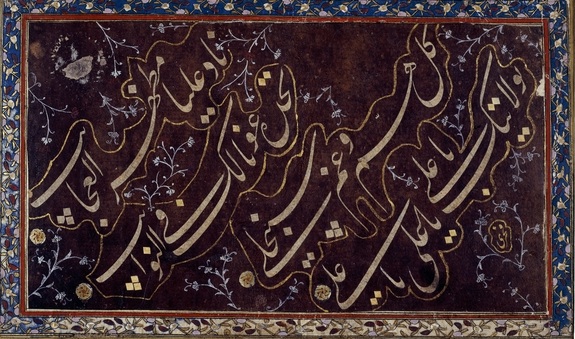
About the calligrapher and calligraphy:
Fakhri of Bursa (d. 1618) was one of a number of Ottoman calligraphers known to have excelled in the delicate craft of qita, or cutout calligraphy. This technique was very popular in 16th/17th century Ottoman Turkey. Lines of finely written text were cut out, including the joining ligatures between the letters, and pasted upon a new page. Alternatively, letters could be cut out from the page, and the remaining sheet superimposed on another, showing the text in recession. Pages of qita were gathered in collectors’ albums, along with paintings and examples of different calligraphic scripts.
The inscription is written in a graceful nasta’liq script. The openwork letters are in a cream ink outlined in gold, and are superimposed upon a brown backdrop with tiny sprays of white flowers. The calligraphy is bordered by a blue frame, filled with a gold trellis hung with pink and red blooms. The signature ‘Fakhri’ is short for Fakhri ibn Vali el-Brusevi, who was well-known as a paper-cutter.
The transliteration and translation are as follows:
Nadi Ali, Nadi Ali, Nadi Ali
Nadi Aliyyan mazhar al-ajaib
Tajidahu aunan lakafin-nawaib
Kullu hammin wa ghammin
sayanj-i Ali Bi wilayatika
Ya Ali, Ya Ali, Ya Ali
Call upon Ali
who causes wonders to appear,
you will find him a help to you in adversity,
all anguish and sorrow will disappear
through your friendship
oh Ali, oh Ali, oh Ali.
The Ismaili Imamat
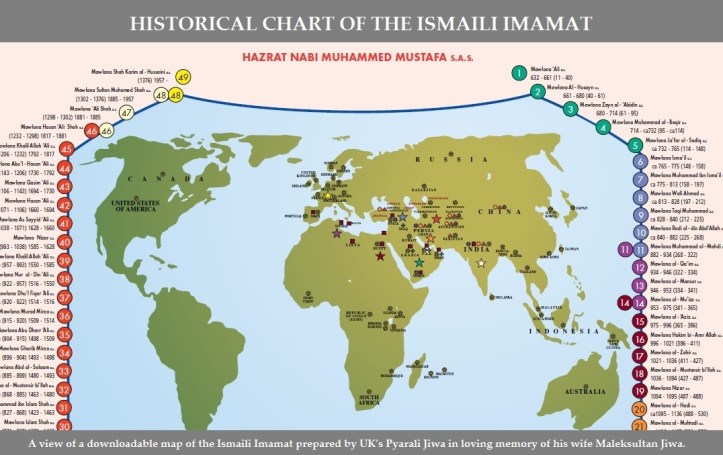
“Each Imam presents to the world of his time that facet of the multi-faceted splendour the Ismailis call Imamat. Ismaili doctrine has emphasised the principle of the Unity of Imamat under the superficial diversity exhibited by each Imam-of-the-Time. It is in this sense that the Ismailis believe that each Imam, as the bearer of the Noor of Imamat, is the same irrespective of his own age or the time he lives in. The proverbial valour and exemplary statesmanship of Imam Mawla Murtaza Ali and the organizing genius of the present Imam, Shah Karim al-Hussaini, are only some of the more spectacular characteristics exhibited by the Imam-of-the-Time in accordance with the exigencies of the situations facing him.” – Late Esmail Thawerbhoy, Simerg
Date posted: March 17, 2019.
Last updated: January 23, 2024.
__________________
PLEASE VISIT BARAKAH’S HOME PAGE AND ITS SISTER WEBSITES
Barakah welcomes your feedback. Please complete the LEAVE A REPLY form below. Your letter may be edited for length and brevity, and is subject to moderation.
Before departing this website please take a moment to visit Barakah’s Table of Contents for links to more than 350 pieces dedicated to Mawlana Hazar Imam, members of his family and the Ismaili Imamat. Also visit Barakah’s two sister websites, Simerg and Simergphotos.
Please follow Barakah’s editor Malik on Facebook and X (formerly Twitter). Malik can be reached at mmerchant@barakah.com.
 Barakah
It is nice to read informative post such as this. Thanks a lot!
LikeLike
This is a great post. There is good information and the best part is that Hazrat Ali is linked with Hazar Imam.
LikeLike
As always thank you for sharing so many important facts through the excerpts that have been provided from numerous sources. For those unfamiliar with Shia Islam and the Ismaili Tariqah, the reading will be very helpful. as important statements connect Mawlana Hazar Imam directly with his ancestors, Hazrat Ali and our beloved Prophet Muhammad.
LikeLike