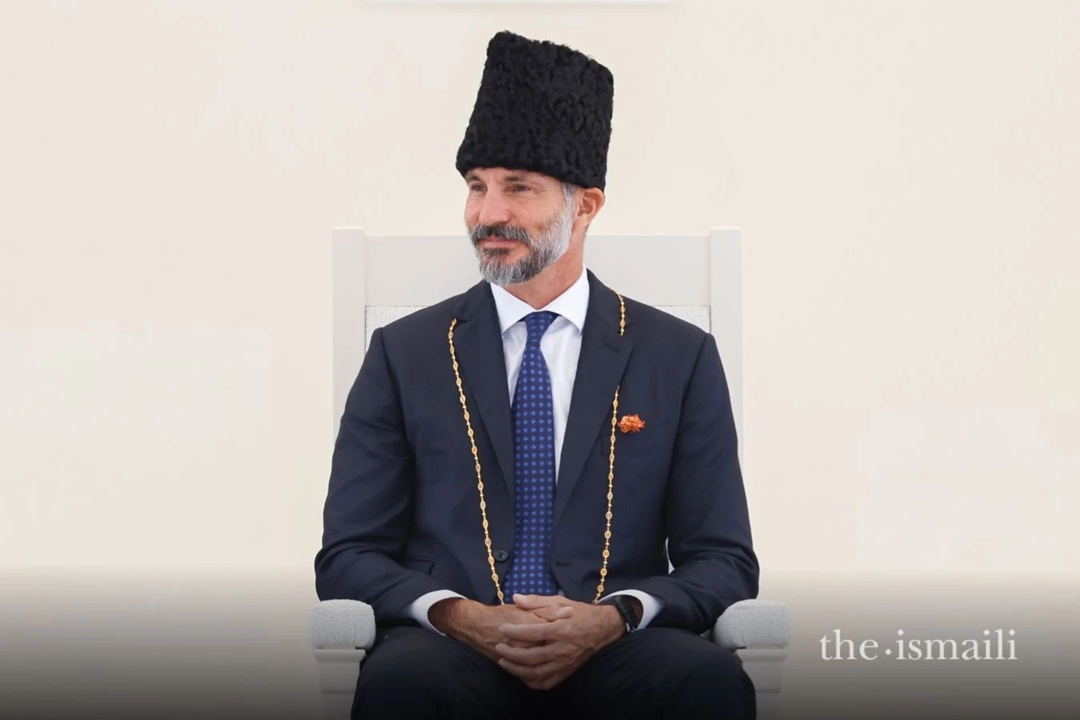
Editor’s Note: Barakah’s correspondents in Chitral and Hunza, Fakhr-e-Alam and Faqir Ullah Khan, respectively, reported on preparations for Mawlana Shah Rahim Hazar Imam’s May 2026 visit to the two regions in Pakistan’s Northern Areas (read the pre-arrival coverage HERE). Following this, we published Faqir Ullah Khan’s account of the Hunza Didar as a photo essay on our photoblog, Simergphotos.
In this exclusive post, we share an account of the Chitral Didar submitted by Fakhr-e-Alam and present a slightly revised version of Faqir Ullah Khan’s Hunza Didar story. We are sure that both Didar stories will inspire other Jamats worldwide as they prepare for their own Didar with Mawlana Hazar Imam. Readers who have already had their Didar will, in their own way, reflect on their experiences as they read the following two accounts. We will, of course, be happy to receive their accounts as well. Please submit them to the editor, Malik, at mmerchant@barakah.com.
1. The Didar of Mawlana Hazar Imam Shah Rahim al Hussaini in Chitral
By FAKHR-E-ALAM
While the Didar (lit. a glimpse) of the Imam-of-the-Time is undoubtedly an important religious and spiritual experience for the Ismaili community, it is also a rare event in a remote, mountainous region such as Chitral.
Historically, the Ismaili community of Chitral had very limited access to the Imam because of geographical and political circumstances. Only Pirs and Khalifas occasionally travelled to Bombay (now Mumbai) or Karachi with the community’s offerings and returned with guidance from the Imam. In 1923, for the first time, a missionary sent by Imam Sultan Mahomed Shah Aga Khan III, Pir Sabz Ali, visited Chitral and Central Asia, introducing several institutional reforms.
His successor, Mawlana Shah Karim, His Late Highness Aga Khan IV, the 49th Hereditary Imam, visited Hunza in 1960 and Chitral in 1976. At the time, poverty and underdevelopment were so widespread that members of the Jamat sat on bare ground to receive the Imam’s Didar. Imam Shah Karim initiated the establishment of institutions in Chitral to improve the community’s conditions, and within decades, significant progress was evident among the Jamat.
The impact of this transformation on economic, social, and educational development was felt and appreciated not only by the Ismaili community but also by other communities in the area. For this reason, the recent historic first Didar in Chitral with Mawlana Shah Rahim Hazar Imam was eagerly anticipated by many non-Ismailis. Hundreds of Sunni Muslims gathered both inside and outside the venues, hoping to catch a glimpse of Mawlana Hazar Imam.
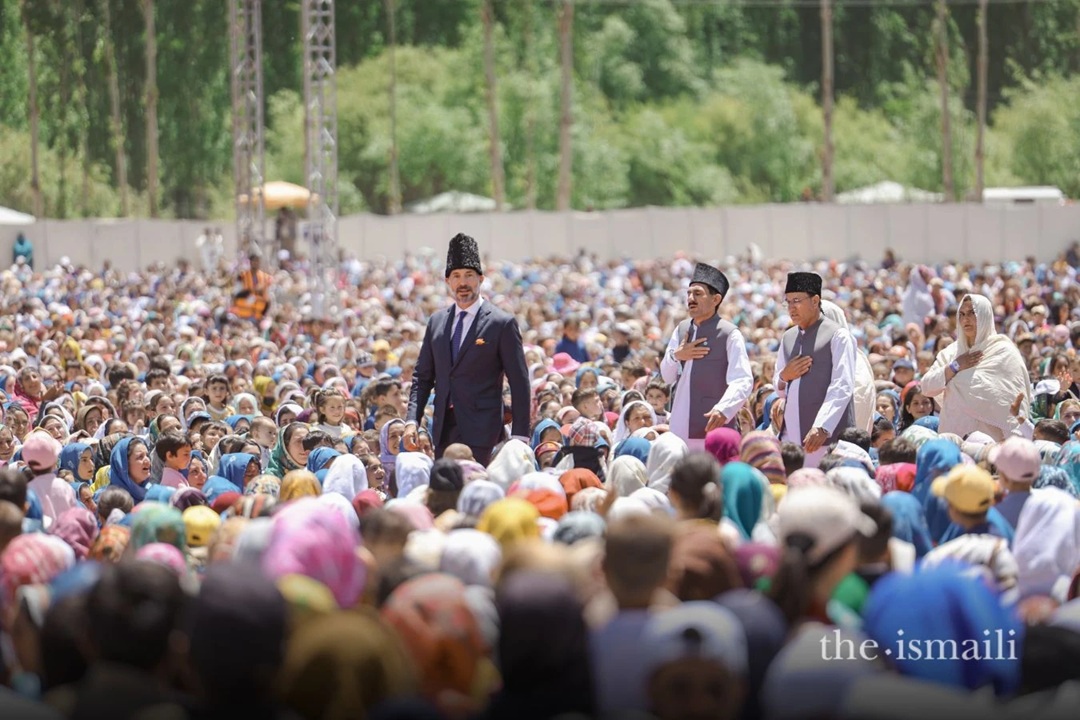
Hazar Imam held three Didar gatherings at two locations in Chitral, attended by tens of thousands of murids and multi-faith families. This was Hazar Imam’s first visit to Pakistan and the Northern Areas as Imam-of-the-Time. During this visit, an excellent demonstration of interfaith harmony was evident in Chitral. The Jamat travelled for hours, and in some cases, days, from remote valleys to attend the Didar. They were welcomed not only by the Ismaili Jamat but also by the Sunni community. Communities near the Didargahs (Didar venues) hosted guest families, while members of the Sunni community guarded the Ismaili community’s properties, cattle, and crops during the Ismaili community’s absence as they attended the Didar.
In the mountains, the Ismaili Jamat had spent days carving welcome messages for Hazar Imam, and the Imam acknowledged them in his Farman (guidance).

On May 23, 2026, Hazar Imam gave his first Didar at the purpose-built Didargah in Parwak, Upper Chitral, where his murids had waited for several hours, enduring a cold night under the open sky. Amid the dark, silent valley stood a vast, brightly lit ground where thousands of people spent the night reciting the Salawat.
When dawn broke, the sky was unexpectedly clear after many days of rain. The concerns that had arisen from the continuous rainfall over several days disappeared. Whatever food people had, they shared it with one another.
As Hazar Imam’s helicopter crossed Shandur Pass and flew over the Mastuj valley, the Jamat’s emotion was moving to witness. At the helipad, Hazar Imam was received by the President of the Ismaili Regional Council Upper Chitral, Imtiaz Alam, Jamati office-bearers, and government officials. Within moments, Hazar Imam was among his Jamat, shaking hands with many of them, particularly children and youth. Imam personally visited the hospital set up beside the pindal (covered structure) to meet bedridden patients and inquire after their well-being.
On the second day, Hazar Imam returned from Gilgit to Upper Chitral to grant Didar to the remaining Jamat. The third Didar in Chitral was held on May 25 in Garam Chashma, Lower Chitral, where a large Ismaili population has lived for centuries. Camps were set up along the routes to welcome and assist the Jamat from distant areas, with proper arrangements for food, lodging, and rest. Thousands of volunteers worked day and night in service to those attending the event. In the afternoon of 25 May, the Imam blessed the Jamat with Didar.
At every location, the hearts of the Jamat brimmed with anticipation for their Imam’s arrival. Eyes were moist with emotion, and prayers and supplications flowed from their lips. After the Didar, people rose to their feet and embraced one another, exchanging congratulations and blessings. Although Eid al-Adha was still a few days away, the atmosphere was no less joyful than on Eid itself.
As Hazar Imam departed from the Didarghas in Chitral, his tens of thousands of murids watched with tearful eyes, hopeful for his return to Chitral, a promise the Imam also made to them.
After the Didar, the volunteers were especially delighted. They had devoted months of preparation and immense energy to making the Holy Didar possible. The leadership, whose organizational skills had ensured the event’s success, also shared in the joy. Yet their work was not finished. They spent the following days, including Eid itself, carrying out post-Didar and closing activities at the venue.
The Didar proved to be much more than a religious gathering. It became a means of bringing together different generations, communities, and isolated valleys. The event left an unforgettable lesson in brotherhood, gratitude, mutual assistance, sincerity, and volunteerism.
Chitral: Mawlana Hazar Imam’s Address to the Community
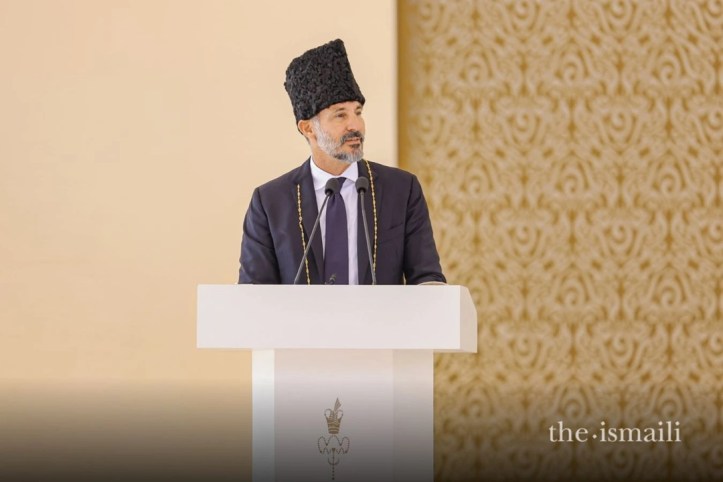
In his guidance, Hazar Imam addressed a wide range of issues, from climate change to technology, and urged the Jamat to be prepared to face both current and future local and global challenges. He advised people to diversify their sources of income but stressed that these must always be ethical and legal.
He encouraged the youth to stop comparing themselves with others or competing out of insecurity, and instead focus on becoming the best version of themselves, according to their own abilities. He told the jamat to move forward, but not alone; rather, to take everyone along. He emphasized learning English to connect better with the rest of Pakistan and the world, and placed special emphasis on trade, tourism, and digital skills. Beyond accumulating information, he asked them to develop creativity and critical thinking, and to broaden their perspectives.
The Imam also reminded everyone of the importance of gratitude towards the Creator. “You should be grateful for these mountains, this sky and this air,” he said, teaching that gratitude should endure in times of ease as well as in times of challenge. He discussed the fundamental Ismaili and Islamic principles that underpin the Jamat’s life. Hazar Imam also reaffirmed his sole authority as Imam-of-the-Time in matters of faith.
Chitral: Mawlana Hazar Imam’s Departure

At Chitral Airport, Hazar Imam met Governor of Khyber Pakhtunkhwa Faisal Karim Kundi, Chief Minister Sohail Afridi, and other political and administrative officials before departing for Islamabad on a special aircraft, marking the end of his visit to Gilgit-Baltistan and Chitral.
This was Hazar Imam’s first visit to Pakistan and the Northern Areas as Imam-of-the-Time. During this visit, an excellent demonstration of interfaith harmony was witnessed in Chitral. The Jamat travelled for hours, and in some cases, days, from remote valleys to attend the Didar. They were welcomed not only by the Ismaili Jamat but also by the Sunni community. Communities near the Didargahs hosted guest families, while members of the Sunni community guarded the Ismaili Jamat’s properties, cattle, and crops while the Jamat was away attending the Didar.
~~~~~~~~~~~
2. The Didar of Mawlana Hazar Imam Shah Rahim al Hussaini in Passu, Hunza
By FAQIR ULLAH KHAN-GHULAM KADIR
The historic Didar — literally a glimpse — of Mawlana Hazar Imam Shah Rahim al-Hussaini in Passu, Hunza, was not only a spiritual gathering but also a remarkable display of unity, hospitality, sacrifice, and devotion. As thousands of Jamati members from southern Hunza were expected to travel to Passu, extensive arrangements were made months in advance. The Local Councils of Gulmit and Gojal Bala coordinated accommodations and conducted detailed surveys. Approximately 14,000 murids from the Local Councils of Shinaki, Aliabad-Hyderabad, and Altit-Karimabad were accommodated in Shishkat, Gulmit, Kamaris, Ghulkin, and Hussaini, while nearly 9,000 others stayed in Khyber, Ghalapan, Moorkhun, Gircha, Sirteez, and Nazimabad. Senior citizens, Differently Abled Individuals (DAIs), bedridden patients, pregnant women, mothers with newborns, and infants were warmly hosted in the traditional homes of Passu villagers. The spirit of service and compassion reflected the true values of a united Ismaili Jamat.
The Local Council of Chipurson, consisting of nine Jamatkhanas, arranged accommodation in Khudaabad and Sost, while the Shimshal Jamat set up well-established, organized tourist tent camps alongside local homes. More than twenty Jamatkhanas and three Local Councils from southern Hunza also arranged camping facilities for murids arriving the night before the Didar.
Despite the extraordinary preparations, the weather in May posed a major test. The camps endured a freezing night followed by heavy rain from early dawn until around 8:00 a.m. Yet the faith and dedication of the Jamat remained unshaken. Thousands began walking toward the Passu Didargah from 4:00 a.m. to reserve their places, despite the rain-soaked conditions. The Karakoram Highway was overwhelmed with traffic, and Passu looked like a bustling megacity filled with spiritual excitement. A few minutes before reaching Passu, you leave behind at the entrance of the Shimshal Valley one of the planet’s most bizarre and majestic mountain formations: the Passu Cones, also known as the Passu Cathedral. Rising to an elevation of 6,106 meters (20,033 feet), these iconic Karakoram peaks are celebrated for their dramatic, symmetrical spires and striking golden glow at sunrise and sunset.
Among the thousands who trekked from Shimshal to Passu — a distance of about 60 km — were my friends Didar Shah, Samana Rahim and Itibar Shah. They completed their walk, which they called the Peace Walk, over a few days, crossing the unbridged Shimshal River, a major tributary of the Hunza River, as well as several glacial streams.

The entire atmosphere at the Didargah reflected the timeless words of our beloved 49th Imam, Mawlana Shah Karim Aga Khan IV:
“No mountain, no river, no desert can stop the love of the Imam for his Jamat worldwide.”
At around 10:00 a.m., the long-awaited announcement was made that Hazar Imam had arrived in Gilgit from Islamabad and was heading to Hunza by helicopter. As the Jamat prayed with gratitude and emotion, the dark skies suddenly cleared, creating an unforgettable moment of spiritual awe.
From the vantage point of Pitkmiss Sar, I witnessed the breathtaking arrival of Hazar Imam’s helicopter and captured the historic landing in Passu. Shortly afterward, I descended quickly and reached the Didargah before the Farman Mubarak began, where I was blessed with the luminous Didar.
Hazar Imam was received by the President of the Regional Council Hunza, Colonel (Retired) Karim, along with government officials, including caretaker Minister Shehbaz Khan and the Assistant Commissioner of Gojal.
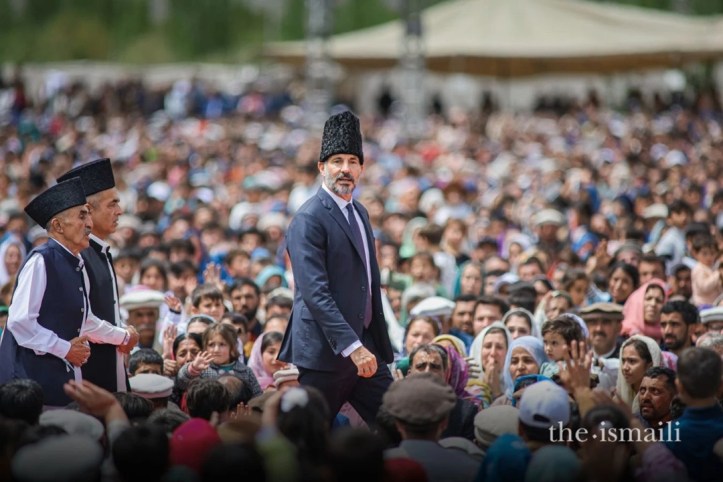
After briefly visiting the Imamat Lounge and donning the traditional cap, Hazar Imam entered the main pindal through a beautifully crafted, four-pillared gate, designed in traditional architectural style by local youth and artisans. He then walked gracefully along a nearly one-kilometre ramp toward the stage, before more than 80,000 murids.
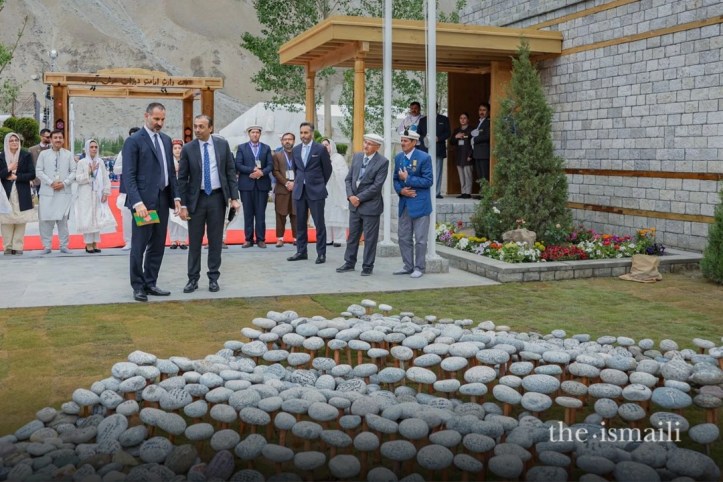
In his Farman Mubarak, Hazar Imam emphasized unity, faith, education, service, and respect for institutions. He especially encouraged youth to think globally, deepen their education, and improve their English to better understand the changing world.
One touching moment occurred when Hazar Imam turned back to bless a newborn baby while greeting murids along the red carpet. He also spent special time visiting the DAIs and patient sheds. Among them was volunteer Liaqat Ali from Hussaini, who had been injured during the facility’s construction and was recovering.
As Hazar Imam departed by helicopter, he circled twice above the Didargah, waving lovingly to the Jamat below. Murids responded with tears, prayers, and heartfelt devotion. Soon after the helicopter disappeared into the mountains, strong winds and heavy rain returned.
Despite exhaustion and harsh weather, the Jamat displayed remarkable resilience. Many returned home late at night, while others stayed in camps or were once again generously hosted by the people of Passu and neighbouring villages. The hospitality shown throughout Gojal demonstrated the beauty of unity, in which every guest was treated with love, dignity, and care as One Jamat.
Date posted: July 12, 2026.
_______________
Please click SUBSCRIBE and enter your email address to receive update notifications from Barakah. Before you leave, remember that Barakah’s editor, Malik, is here to assist you. If you have any questions or feedback, please scroll down to leave a comment or send an email to mmerchant@barakah.com. Also, don’t miss the opportunity to explore the diverse and extensive content on Barakah’s Home Page or Table of Contents, with over 400 pieces dedicated to Mawlana Hazar Imam, members of his family and the Ismaili Imamat. And don’t forget to visit our sister websites, Simerg and Simergphotos. You can stay updated by following Malik on @Facebook, @X, @LinkedIn and @Instagram and by subscribing to Barakah.
_______________
ABOUT THE AUTHORS

Faqir Ullah Khan-Ghulam Kadir is an Aga Khan Education Services Pakistan (AKESP) teacher, educator, instructional leader, and Study of United States Institute (SUSI) alumnus. He has served across Early Childhood Education (ECD) to college levels, fostering learning and leadership. As Aga Khan Youth and Sports Board (AKYSB) Chairman and an Ismaili Tariqah and Religious Education Board (ITREB) educator, he has contributed to strengthening youth and religious education. From nurturing students at Shah Karim Hostel in Gilgit to leading innovative initiatives such as the Mountain Folk Music Integration Program and community-based college development, Faqir’s journey reflects a commitment to transformative education, global exposure, and the empowerment of diverse, remote communities.
~~~~~~~~

Fakhr-e-Alam is a journalist from Chitral. His writings have appeared on various online and print platforms in Pakistan.
 Barakah
Thank you, Fakhr-e-Alam and Faqir Ullah Khan, for sharing your stories about Mawlana Hazar Imam’s visits to Chitral and Hunza. Your beautiful writing and your detailed accounts of Hazar Imam’s visits were deeply uplifting.
Reading this brought tears to my eyes and reminded me of The Almighty Lord’s grace and of the blessing received by the people of Northern Pakistan. I am holding beautiful thoughts of Hazar Imam blessing His murids. Alhamdulillah.
Thank you for making my day. Peace and blessings to you. May the Lord continue to guide your beautiful spirit and keep presenting and sharing posts about reality and non-fiction.
LikeLike