
Prepared and compiled by MALIK MERCHANT
India and the world are deeply saddened by the loss of one of its former Prime Ministers, Dr. Manmohan Singh, who has passed away at the age of 92. He was admitted to All India Institute of Medical Sciences late on Thursday, December 26, 2024, after his health deteriorated due to a sudden loss of consciousness at home.
Dr. Singh was regarded as the architect of India’s economic reform program. He served two terms as Prime Minister from 2004 to 2014, and he had never been elected to a public office before then.
A member of the Indian National Congress, Singh was the first Sikh Prime Minister of India. He was born in 1932 in the village of Gah, in what is now Pakistan, and moved to India with his family during the partition. Dr. Singh studied economics to find a way to eradicate poverty in India. He won scholarships to attend Cambridge, where he obtained a first in economics, and Oxford, where he completed his doctorate. Dr. Singh worked in a string of senior civil service posts, served as a central bank governor, and held various jobs with global agencies such as the United Nations.
The Indian Government has announced seven days of state mourning throughout India in Dr. Manmohan’s honour. The national flag will also be flown at half-mast. India’s cricket team, battling hosts Australia in the fourth Test in Melbourne, took to the ground Friday with black armbands to show respect for the late Prime Minister.
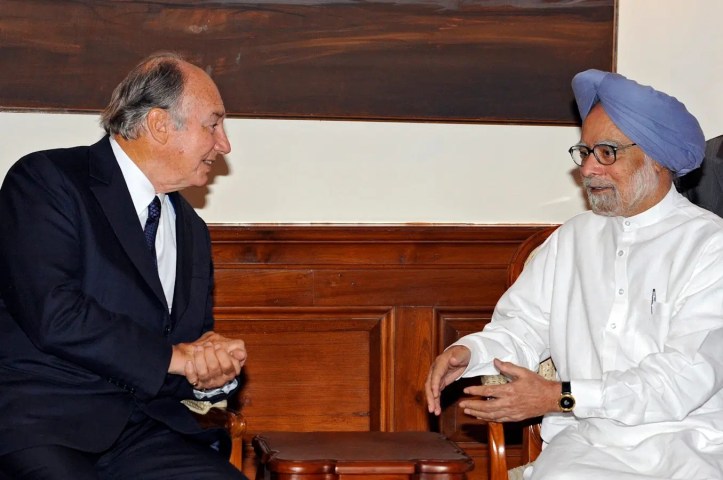
As our thoughtful tribute to the late Prime Minister, we present this insightful post that includes photographs of Mawlana Hazar Imam, His Highness the Aga Khan, with Dr. Manmohan Singh taken in 2004, 2008 and 2013. The three visits covered significant historical and cultural events related to the Ismaili Imamat and the Aga Khan Trust for Culture, an Aga Khan Development Network agency.
2004: The Aga Khan and Prime Minister Manmohan Singh Announce Aga Khan Award for Architecture prize winners
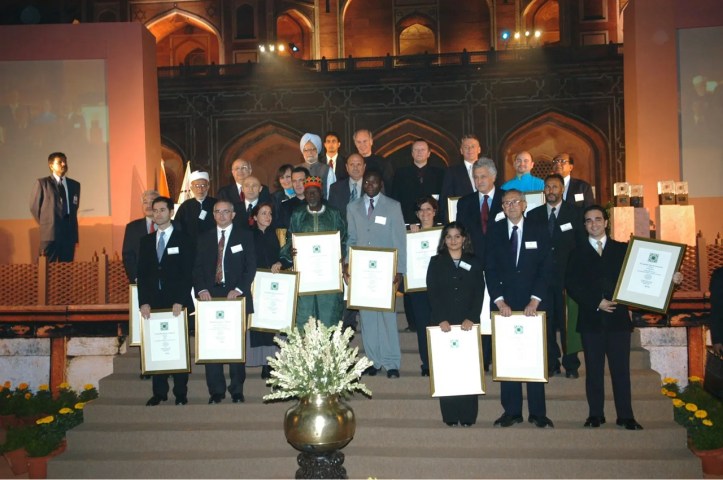
Dr. Manmohan Singh took the oath as the Prime Minister of India on May 22, 2004. In November of the same year, he and His Highness the Aga Khan, the 49th Hereditary Imam of the Ismaili Muslims, announced the seven recipients of the ninth cycle of the Aga Khan Award for Architecture, the world’s most significant architectural award.
Praising the Ismaili Imam for the work done in restoring historical monuments, the Prime Minister said this had been an instructive example of finding new and creative solutions to the age-old problem of allocating scarce resources in a developing country to the preservation of heritage. “I hope that more public-private partnerships can be evolved to maintain and restore the monuments of our ancestors, which often lie in neglected condition in our cities and towns,” he said. Drawing attention to the milieu in which the heritage of buildings existed, Dr. Manmohan Singh urged every Indian to take pride in this legacy, and to “contribute to ensuring that there remains a legacy for which our descendants can be proud.” Further reflecting on the development initiatives undertaken in India by the Aga Khan, Dr. Singh said, “We see these as symbols of His Highness’s vision for the world; a vision that is imbued with the true spirit of compassion, humanism and social conscience. These are truly the hallmark of Islam.”
VIDEO
_____________________
2008: The Golden Jubilee visit of His Highness the Aga Khan
Mawlana Hazar Imam landed in New Delhi, on May 12, 2008 to commence his eight-day Golden Jubilee visit of India. He was received at the airport by the Minister of State for External Affairs, Mr E. Ahmad, the Foreign Secretary, Mr Shivshankar Menon, the Chief of Protocol for the Government of India, Mr Sunil Lal, and leaders of the Jamat in India. During the course of the day, Mawlana Hazar Imam met with the Minister of State for External Affairs, Mr E. Ahmad, the Honourable Vice President, Mr Mohammad Hamid Ansari, the Prime Minister, Dr Manmohan Singh and the Chairperson of the ruling United Progressive Alliance, Mrs Sonia Gandhi.
_____________________
2013: The Aga Khan and Prime Minister Manmohan Singh Inaugurate the Restoration of Humayun Tomb
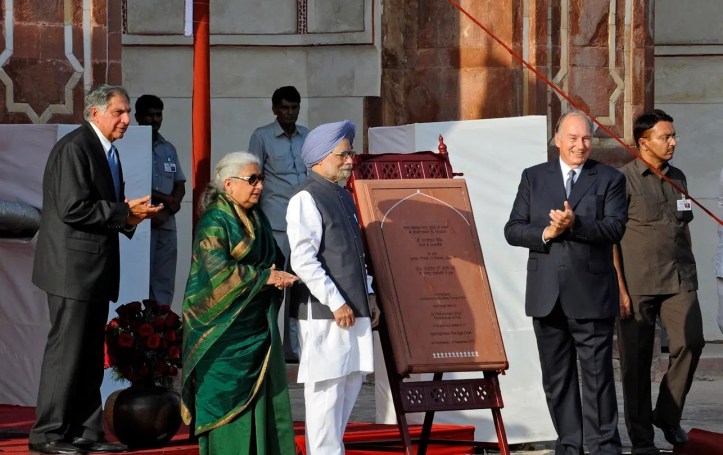
The restoration of the Mughal Emperor Humayun’s 16th century garden tomb, the jewel of Mughal architecture that predates the Taj Mahal, was inaugurated on September 18, 2013, by India’s Prime Minister, Dr Manmohan Singh, Union Minister of Culture Mrs Chandresh Kumari Katoch, Chairman of the Sir Dorabji Tata Trust, Mr Ratan Tata, and Mawlana Hazar Imam. Mr. Ratan Tata, it might be noted, passed away on October 9, 2024, at the age of 88.
Excerpts from the Prime Minister’s Speech
I would also like to personally thank His Highness the Aga Khan for his commitment to revitalising historic centres, here in India and abroad. We are fortunate to count him as a great friend of Indian heritage and I have no doubt that we will be able to continue this rich partnership into the future — Prime Minister Manmohan Singh (for full speech click HERE)
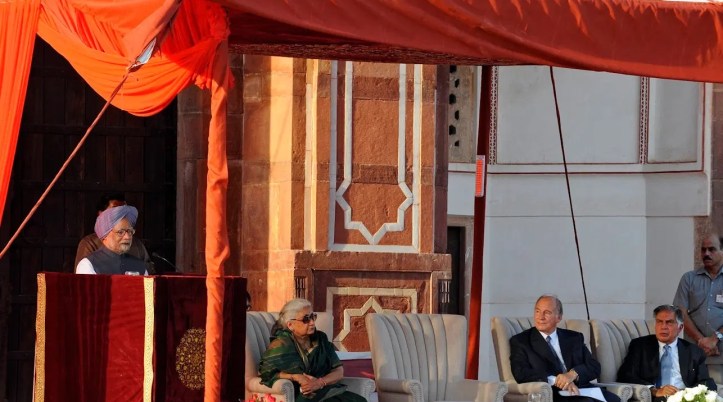
“It gives me great joy to be here this evening in a spot that is replete with the grandeur of nearly five hundred years of Indian history. The famous architect, Frank Gehry, once said: “In the end, the character of a civilization is encased in its structures.” This complex is an important marker of our civilization and it is, therefore, a privilege for me to join you at this ceremony marking the completion of almost seven years of painstaking restoration work by the Aga Khan Trust for Culture, in partnership with the Archaeological Survey of India, and with the support of the Sir Dorabji Tata Trust.
“India has one of the richest repositories of heritage anywhere in the world and it is critical that we find practical and innovative ways to preserve and maintain this heritage. I recall that, in November 2004, speaking at this very spot on the occasion of the presentation of the Aga Khan Award for Architecture, I had expressed the hope that a public private partnership could be created to maintain and restore historic monuments.
“The key to the success of this conservation initiative here at Humayun’s Tomb has been partnership between like-minded public and private agencies, seized with concern for the protection of the national heritage, and able to work in a transparent and inclusive manner with local communities.
“The responsibility to conserve and restore our nation’s heritage cannot simply be the sole preserve of government agencies, especially in a country where the physical manifestations of our past are so numerous, and often appear to be at risk of being overwhelmed by the pace of present development. The involvement of the local communities who form part of the ecosystem of this heritage is, therefore, essential in this effort.
Prime Minister’s speech continues below
_____________________
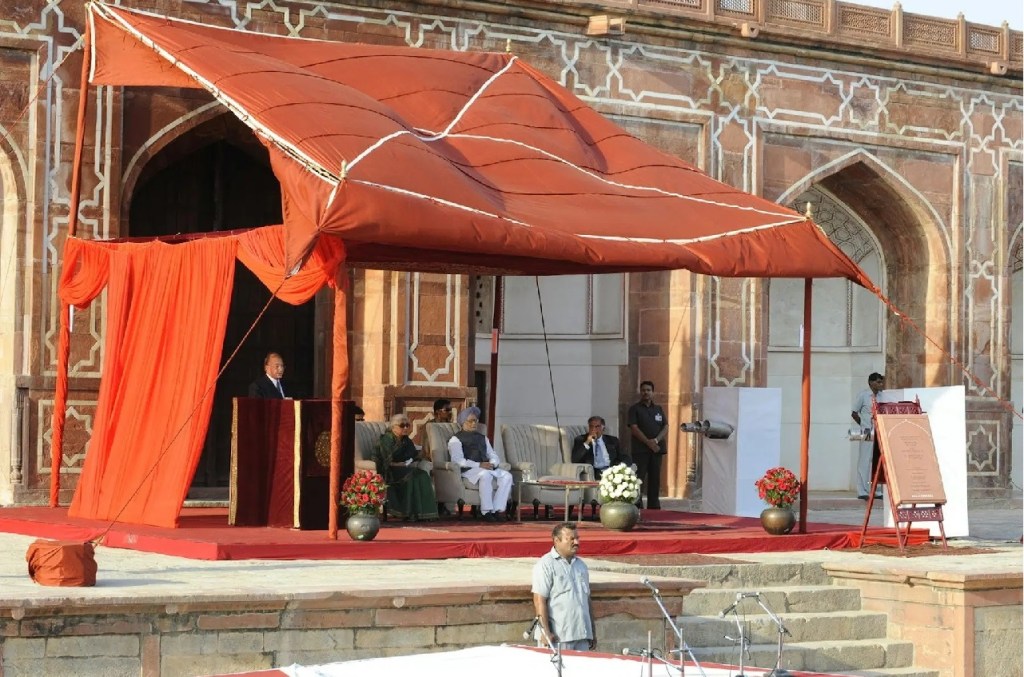
Let me first extend my special thanks to the Prime Minister, whose presence honours all of us. There is another very important reason for me to salute the Prime Minister today. It was he who first recommended to the Aga Khan Trust for Culture that projects like this, should be built on public private partnerships. We heeded his suggestion. And today, the great majority of the 20 similar projects we have undertaken, are founded on public private agreements — His Highness the Aga Khan, read full speech HERE.
_____________________
“I would like to congratulate the Aga Khan Trust for Culture, the Archaeological Survey of India and the Sir Dorabji Tata Trust on the success of this endeavour, which has spared no resources and no effort to bring our systems at par with the best in the world and provide a model for conservation to the world. I would also like to personally thank His Highness the Aga Khan for his commitment to revitalising historic centres, here in India and abroad. We are fortunate to count him as a great friend of Indian heritage and I have no doubt that we will be able to continue this rich partnership into the future.
“With these words, I thank you all and I wish you a very good evening.”

~~~~~~~~
VIDEO
Date posted: December 27, 2024.
_________________
fEEDBACK
Barakah welcomes your feedback. Please scroll down for the COMMENT box. Your letter may be edited for length and brevity and is subject to moderation.
TABLE OF CONTENTS AND SISTER WEBSITES
Before departing this website, we encourage you to visit Barakah’s Table of Contents for links to more than 325 pieces dedicated to Mawlana Hazar Imam, members of his family and the Ismaili Imamat. Also, visit our two sister websites, Simerg and Simergphotos. Barakah’s editor may be reached at mmerchant@barakah.com. To stay connected and be part of the Barakah community, please follow Malik @Facebook and @X (formerly known as Twitter).
 Barakah