
In The Book of Travels, Nāṣir-i Khusraw [1] recounts a dream that altered the course of his life. In the dream, he is told: “Seek that which increases reason and wisdom.” Perplexed, he asks, “Where can I find such a thing?” This question, simple yet seismic, becomes the axis of his transformation. Upon awakening, Nāṣir begins a journey that leads him across lands and empires until he reaches Cairo, where he is ushered into the presence of the Imam-of-the-Time, al-Mustanṣir bi’llāh (d. 1094). There, he takes the oath of allegiance.
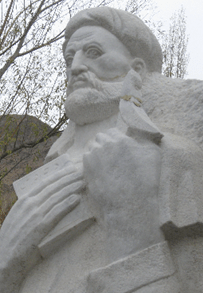
This moment is not merely biographical; it is archetypal. It is the enactment of the sacred murīd–murshid relationship — the cornerstone of Nizari Ismailism. Pir Ḥasan Kabīr Dīn, in his tender Ginan Āvo Rikhīsaro Tame Tīrath Nahāve [2], verse 9, alludes to this very bond. He reminds us that the oath of allegiance (bay‘at) and the recognition of the Imam (ma‘rifat) are inseparable. One cannot exist without the other. Recognition is not an intellectual exercise; it is a covenant of the soul:
Jirebhai kann’kaṇ vinā vīra oḷakhāṇ nahī,
Te to tame kāya n bandhāvo.
Translation:
Dear Brother, without kann’kan (oath of allegiance).
there is no recognition (of the Imam),
why are you hesitant to perform it?
It is in this spirit that we turn to the luminous insights of Henry Corbin, W. Ivanow, and Pir Shihāb al‑Dīn Shāh, whose writings help us distil a comprehensive understanding of one of the most essential themes in Nizari Ismailism: the Recognition of the Imam. When their works are woven together with the devotional wisdom of the Ginans, especially Partak Pātra ne Parkhīne, a single, unbroken truth emerges: the leitmotif of Nizari Ismailism is the quest to recognize “he who is in authority,” for upon this recognition depends the salvation of the soul. And salvation, in the language of the Ginans, is nothing less than the unveiling of amer bhed, the secret of immortality.

Henry Corbin, in his profound study of Ismaili metaphysics, describes the Imam as the earthly homologue of the Universal Soul. In one of his most striking formulations, Corbin writes that the Imam is “the epiphany of the spiritual world in the world of form [3].” He is the bridge between the invisible and the visible, the eternal and the temporal. The Imam is not merely a religious authority; he is the mirror in which divine reality becomes accessible to human consciousness. Without this mirror, the soul remains unable to perceive its origin or its destiny.
This metaphysical role is not abstract. It is the very heartbeat of Ismaili spirituality. Just as the Universal Soul animates and orders the cosmos, the Imam animates and orders the inner world of the believer. To recognize the Imam is to awaken to the structure of reality itself, to see the world not as a series of disconnected events, but as a purposeful unfolding guided by a living principle of Light.
W. Ivanow, in his treatise On the Recognition of the Imam [4], brings this cosmic vision into the language of lived religion. He offers a metaphor that has become central to modern Ismaili understanding: the Imam is the captain of the ship. Ivanow writes that “without the Imam, the believer is like a ship without a captain, drifting on the sea of existence.” The world is an ocean — vast, shifting, filled with currents of illusion — and the human soul is a traveller seeking the far shore. Without the Imam, the ship is directionless; with him, the believer is guided safely through storms of doubt, confusion, and suffering.
And yet, the Imam’s guidance is not only spiritual. The material world, too, is a sea of illusions, temptations, and trials. The Qur’anic term dunyā captures this beautifully: a realm of nearness, immediacy, and distraction. The Imam, as the bearer of Light, provides his murīds with the ethical, intellectual, and practical guidance needed to navigate this world with clarity. His counsel on justice, education, health, dignity, and balance is not separate from his spiritual role — it is an expression of it. Thus, the Imam is the captain not only of the soul’s inner voyage but also of the believer’s journey through the complexities of daily life.
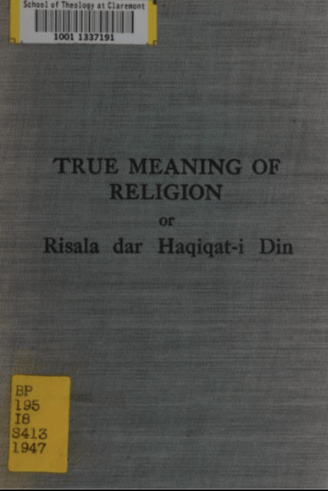
Pir Shihāb al‑Dīn Shāh, in The True Meaning of Religion [4], deepens this understanding by explaining that the Imam is the bearer of the eternal Light (nūr‑i ilāhī) that has passed through the chain of prophets and Imams since the dawn of creation. He writes that “the Light of Imamat is the same Light that shone in the Prophet and in Ali, and it continues in the Imam of every age.” This Light is not symbolic; it is the very substance of inner and outer life. Religion, Shihāb al‑Dīn Shāh reminds us, is not complete without this Light, because religion is not merely a set of teachings – it is a living connection to the divine. The Imam is the seat of Imamat, the repository of this Light, and the channel through which divine guidance flows into the world.
When we turn to the Ginans, we find these philosophical truths expressed in the language of devotion, intimacy, and longing. In Partak Pātra ne Parkhīne [5], Sayyid Imam Shāh urges the seeker to “recognize the manifest character” – to discern the Imam who stands before the world in human form. Recognition is not a matter of external signs alone; it is a matter of inner discernment, of testing with the heart as much as with the mind. The believer must cultivate parkh, the capacity to distinguish truth from illusion, Light from shadow. Only then can one recognize the Imam as the true vessel of salvation.
This theme is echoed with profound tenderness in Pir Ṣadardin’s Mārī Ātmanā Odhār [6]. In its concluding verse, the Pir proclaims that the True Guide “holds the collar of the believer and leads him across the bhav sāgar.”Here, bhav sāgar — the ocean of becoming — is the symbolic landscape of worldly life: its temptations, its anxieties, its glittering distractions, and its subtle snares.
Pīr Sadaradīn pakaḍī bāhyī, bhāv sāgar utāryā re.
Translation:
Pir Sadradin will hold you by the collar and set you on the far shore of safety.
It is the same ocean Ivanow describes when he speaks of the believer as a ship adrift without the Imam. Pir Ṣadardin’s imagery adds a deeply personal dimension: the Guide does not merely point the way; he grips the seeker with compassion, ensuring that the soul does not drown in the currents of illusion.
This movement from illusion to illumination is captured with striking symbolism by Satgur Nūr [7], the earliest composer of the Ginans. He speaks of the Rūpal Kaṭārī, the dagger of silver — pure, untarnished, and sharp. This dagger symbolizes the cutting away of ego, the draining of pride, the piercing of the heart so that the pain of love may arise.
Jī re bhāī, rūpal kaṭārī tan māhe mārīe ane vindhīye angō‑ang, Pīḍā jo hove prem kī, to jāī mīle hārī rang.
Translation:
Dear brother, pierce your being with the silver dagger; if it awakens the pain of love, then — and only then — will you attain the true colour of the Beloved.
To be coloured by the Beloved is to yield, in love, to the Beloved. It is to let him steer the ship of the soul. It is to see in him the reflection of the Universal Soul and, through him, to glimpse the Supreme Reality. And it is to trust, as Pir Ṣadardīn assures us, that the Imam or his appointed guide will hold our collar firmly, guiding us safely across the ocean of worldly existence to the dry shore of truth.
This recognition is the foundation of the Ismaili path. It is the beginning of the journey toward inner vision. And it is the theme that the Ginans return to again and again, reminding us that the Imam is both the secret and the revealer of the secret, both the destination and the guide.
Date posted: March 4, 2026.
________________

About the author: Shiraz Pradhan is an international consulting engineer, author, and long‑time researcher of the Ginan tradition. He serves as the Chairperson of the Association for the Study of Ginans, an international organisation dedicated to preserving and advancing Ginan scholarship. Shiraz has written extensively on Nizari Ismaili Ginans and Satpanth in Ilm (Ismailia Association UK, 1987) and on Simerg. His interests span the Vedas, Judeo‑Christian history, and Sufism, reflecting his broad engagement with spiritual traditions. His forthcoming book, Amrapuri: Exploring the Evolution of Nizari Ismaili Satpanth through the Prism of Ginan Literature, brings together years of dedicated study.
REFERENCES
- Nāṣir-I Khusraw, and W M Thackston. 1986. The Book of Travels = (Safarnáma). Albany, Ny: State University Of New York Press.
- Kabir Din, Hasan, “Āvo Rikhīsaro Tame Tīrath Nahāve,” Collection of Ginans Composed by Pir Hasan Kabit Din and other Authorized Pirs,” Ismaili Printing Press, Bhimpur, Mumbai, n.d. [Gujarati], #5, p.12
- Corbin, Henry. 1983. Cyclical Time and Ismaili Gnosis. Routledge.
- Wladimir Ivanow. 1947. On the Recognition of the Imam.
- Sayyid Imamshah, “Partak Pātra ne Parkhīne,” Collection of Ginans Composed by Sayyid Imamshah, Ismaili Printing Press, Bhimpur, Mumbai, n.d. [Gujarati], #98. P130.
- Sadardin, “Mārī ātamanā odhār,” Collection of Ginans Composed by Pir Sadardin, Ismaili Printing Press, Bhimpur, Mumbai, n.d. [Gujarati], #137, p.141.
- Satgur Nur, “Jīrebhāī rūpal kaṭārī tan māhe,” Collection of Ginans Composed by Pir Hasan Kabir Din and other Authorized Pirs,” Ismaili Printing Press, Bhimpur, Mumbai, n.d. [Gujarati], #2, p.114
_______________
Please click SUBSCRIBE and enter your email address to receive update notifications from Barakah. Before you leave, remember that Barakah’s editor, Malik, is here to assist you. If you have any questions or feedback, please scroll down to leave a comment or send an email to mmerchant@barakah.com. Also, don’t miss the opportunity to explore the diverse and extensive content on Barakah’s Home Page or Table of Contents, with over 350 pieces dedicated to Mawlana Hazar Imam, members of his family and the Ismaili Imamat. And don’t forget to visit our sister websites, Simerg and Simergphotos. You can stay updated by following Malik on @Facebook, @X, @LinkedIn and @Instagram and by subscribing to Barakah.
 Barakah
Thank you, Shirazbhai, for this insightful and enlightening essay.
LikeLike